

The Concept and Views on Human Capital
INTRODUCTION
Professional accountants, institutional investors, and e-accounting practitioners increasingly recognize the need to develop financial and management accounting concepts and practices that adequately acknowledge the importance of human capital in business organizations. Human capital refers to the knowledge, skills, experience, abilities, and competencies that employees contribute to an organization’s operations and overall performance. Regardless of whether a business operates in manufacturing, services, or technology, the value of its workforce cannot be overlooked. Employees contribute to productivity, innovation, decision-making, and organizational development. Consequently, the measurement and management of human capital costs have become increasingly important across various industries, including insurance companies, banks, and technology-based enterprises. Chen and Lin (2004) emphasize that professionals and organizations from different industries and backgrounds increasingly recognize the need to focus on human capital and its related issues.
The primary objective of most business organizations is to invest capital in ways that maximize profitability and shareholder value. However, in the modern business environment, financial investment alone is insufficient to guarantee organizational success. The effective implementation of business strategies also depends on access to intellectual knowledge, operational expertise, customer relationships, supplier networks, and a committed workforce. These intangible resources contribute significantly to organizational efficiency, competitiveness, and long-term growth. Human capital is particularly important because employees apply their knowledge, experience, and abilities to manage these resources and transform them into productive outcomes. Therefore, organizations must recognize that their success depends not only on the financial capital they possess but also on the quality and capabilities of their employees.
Human capital investment involves the resources organizations devote to recruiting, training, developing, motivating, and retaining employees. These investments can improve workers’ competencies, enhance productivity, reduce operational errors, and strengthen the quality of products and services. In addition, organizations that prioritize employee development may become better equipped to adapt to technological changes, respond to customer needs, and maintain a competitive position in the marketplace. For these reasons, accounting and management practices should provide relevant information about the costs and benefits associated with human capital development. Although employees are valuable organizational resources, their value is not generally recognized as an owned asset in conventional financial statements because organizations do not own their employees and cannot fully control their future service. Nevertheless, human capital information can support internal planning, workforce management, and strategic decision-making.
The significance of human capital is further illustrated by Carnegie (1919, p. 3), who stated, “The only irreplaceable capital an organization possesses is the knowledge and ability of its people.” This statement emphasizes that employees’ knowledge and abilities are essential to the continued success of an organization. It also highlights the need for businesses to recognize the contribution of their workforce when evaluating organizational performance and planning for future development. Effective human capital management enables organizations to build a skilled, motivated, and adaptable workforce capable of achieving strategic objectives. Therefore, the integration of human capital considerations into management and accounting practices can help organizations make better-informed decisions about employee development, operational efficiency, and sustainable growth. Ultimately, recognizing the importance of human capital is essential for businesses seeking to create long-term value for shareholders while maintaining organizational effectiveness and competitiveness.
The Concept of Human Capital
Human capital refers to the economic value of a worker’s experience and skills. This includes assets like education, training, intelligence, health, loyalty, and other attributes that employers value. According to the OECD (1998), human capital is defined as “the knowledge, skills, competencies and other attributes embodied in individuals that are relevant to economic activity.”
The term “capital” in this context represents the idea that individuals invest in themselves—through education, training, and health care—to improve their productivity and value in the labor market. This contrasts with physical capital (like machinery and buildings) or financial capital (like money), yet it shares a similar role in driving economic growth and organizational performance.
Historical Evolution of Human Capital Theory
The concept of human capital can be traced back to classical economics, particularly the works of Adam Smith. In The Wealth of Nations (1776), Smith argued that the acquisition of skills and knowledge is akin to acquiring a machine or tool that enhances labor productivity. However, it was not until the mid-20th century that human capital theory gained formal recognition.
Key Milestones:
Adam Smith (1776): Proposed the idea that education and training are forms of capital investment.
Alfred Marshall (1890): Acknowledged the role of human effort and education in the production process.
Theodore W. Schultz (1961): Credited with formalizing the human capital theory. Schultz argued that investment in education and health contributes significantly to economic growth.
Gary Becker (1964): Expanded the theory in his book Human Capital, quantifying the return on education and other human development investments.
These economists laid the foundation for modern labor economics and influenced policies regarding education, training, and workforce development globally.
The Concept and Views on Human Capital
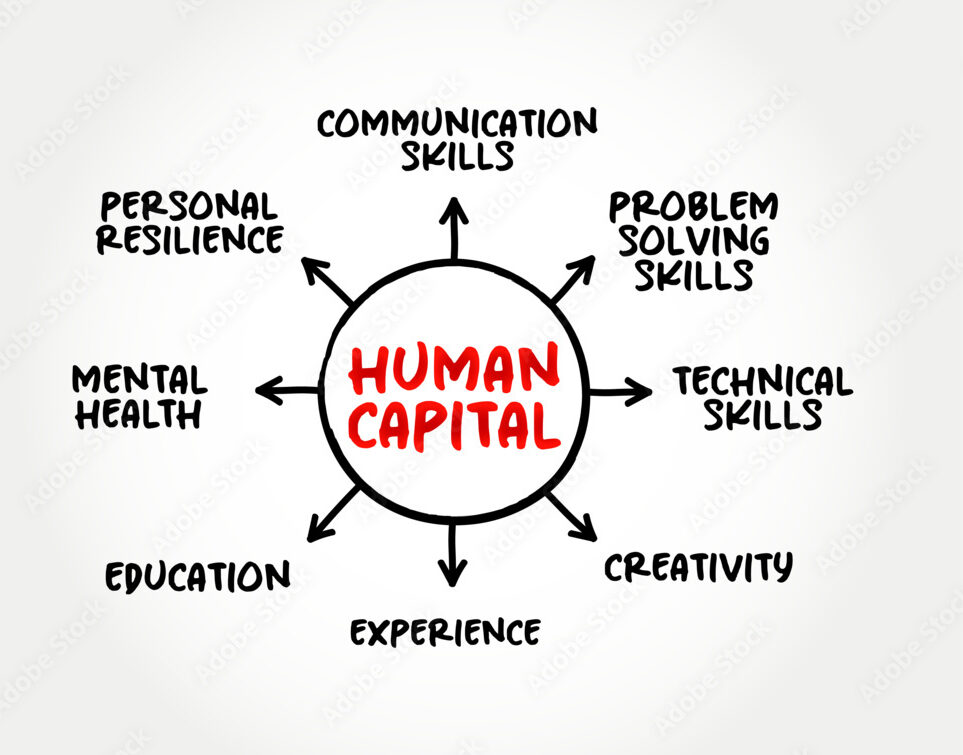
Core Components of Human Capital
Human capital consists of both quantitative and qualitative aspects:
Education and Training: The most visible and measurable form of human capital. It enhances individuals’ cognitive and technical abilities.
Health and Well-being: A healthy workforce is more productive, less absent, and more energetic.
Experience: Work experience builds tacit knowledge, problem-solving abilities, and job-specific skills.
Skills and Competencies: These include both hard (technical) skills and soft (interpersonal, communication, leadership) skills.
Innovation and Creativity: The capacity to generate new ideas and improve existing processes is a vital component of human capital.
Social and Emotional Intelligence: Influences collaboration, teamwork, and organizational culture.
Theoretical Views on Human Capital
Various economic and management theories have addressed human capital, each emphasizing different dimensions:
1. Neoclassical Economic Theory
This theory views human capital as a form of capital analogous to physical capital. It emphasizes investment in education and training as a means to increase productivity and income. The theory assumes individuals are rational actors who invest in themselves to maximize future returns.
2. Endogenous Growth Theory
Championed by economists like Paul Romer, this theory places human capital at the center of long-term economic growth. It argues that technological change and knowledge spillovers arise from investments in human capital, making education and innovation central to national prosperity.
3. Resource-Based View (RBV) of the Firm
In strategic management, the RBV suggests that human capital can be a source of sustainable competitive advantage if it is valuable, rare, inimitable, and non-substitutable (VRIN). Skilled and talented employees are seen as unique resources that differentiate firms in the marketplace.
4. Human Development Theory
Associated with Amartya Sen and the United Nations Development Programme (UNDP), this view sees human capital not just as a means to economic ends but as an end in itself. The focus here is on expanding human freedoms, capabilities, and quality of life.
Modern Perspectives on Human Capital
In recent decades, several new perspectives have emerged, reshaping the traditional view of human capital:
1. Knowledge Economy Perspective
As economies become more knowledge-driven, human capital is increasingly defined by intellectual capabilities rather than physical labor. The World Bank emphasizes that in a globalized, digital world, countries must prioritize investments in knowledge, innovation, and lifelong learning.
2. Human Capital and Technological Change
With the rise of automation and artificial intelligence, there is growing interest in reskilling and upskilling the workforce. Human capital today is not static; it must adapt rapidly to changing technological landscapes.
3. Social Capital and Human Capital Interplay
Recent studies have examined the interaction between social capital (networks, trust, and norms) and human capital. High levels of social capital can enhance the returns on human capital by facilitating collaboration and information sharing.
4. Behavioral Economics Perspective
Traditional models assume rationality, but behavioral economics introduces psychological and social factors. For instance, people may underinvest in their education due to present bias or lack of information.
Significance of Human Capital in Development and Organizations
1. Economic Development
Empirical studies have shown that countries with higher levels of human capital tend to grow faster. Education and health improve labor productivity, innovation, and social cohesion. Human capital is crucial for poverty reduction, gender equality, and sustainable development.
2. Organizational Performance
In businesses, human capital affects everything from productivity to innovation and employee engagement. Organizations that invest in employee training, health benefits, and career development often experience lower turnover, higher efficiency, and stronger competitiveness.
3. National Competitiveness
Global indices such as the Human Capital Index (HCI) and Global Competitiveness Report assess nations’ ability to develop and utilize their human capital. High scores are associated with better economic outcomes and governance.
The Concept and Views on Human Capital
Challenges in Human Capital Development
Despite its importance, human capital faces several challenges:
Inequality in Access to Education and Health Services
Brain Drain in Developing Countries
Underemployment and Skill Mismatch
Inadequate Investment in Adult Learning and Lifelong Education
Low Human Capital in Conflict and Post-conflict Zones
These issues hinder both individual progress and national development and require targeted policy interventions.
ECONOMIST VIEW OF HUMAN CAPITAL
Undoubtedly, in modern economic theory Human Capital Theory is one of the important theoretical foundations to account for the human capital dimension. However, the extensive definitions of human capital create accounting obstacles. Therefore, it is necessary to categories the various definitional notions to identify a practical definition for human capital. Presently, there are three basic views for the notion of human capital.
The first is the investing view, which conceives that human capital is the result of investment, and so the human capital value is the expenditure that is invested to enhance personal physical strength and intelligence, and acquire knowledge and skills (Schultz 1961). The second is the view of part outputs, which conceives that human capital is proprietary knowledge, and skill, experience and the relevant workplace competencies of managers and technical innovators (Weijie & Zhao 2001). The third is the holistic output view, which conceives human capital as the total value of personal physical strength, intelligence, and knowledge and skills for utilization.
ACCOUNTANTS VIEW OF HUMAN CAPITAL
The second area of human capital is often seen as invisible assets and processes, ‘non-thinking’ capital, such as relationships (e.g. customer retention, length of supplier relationship); internal efficiency (e.g. revenues from patents, processes completed without error); renewal and development (e.g. percentage of business from new products, new patents filed, and training costs per hour per employee). This second area is more aligned to the accountants where they view human capital from the valuation perspective. These types of measures can be combined into a weighted intellectual capital index, which, on the surface, has meaning and rigor.
EVOLUTION OF THE TERM ‘HUMAN CAPITAL’
Over the years, various terms have been used to describe one of the major factors of production in basic economics. It has, at various times, been referred to as labour, other refer to it as personnel. With the growing realization of the need to emphasize the importance of man in a work setting, the word human resource evolved. In recent times, to further reemphasize the strategic importance of the role of men in the organization, the terminology now used is human capital. The term human capital dates back to Jacob Mincer’s (1958) pioneering article ‘Investment in Human Capital and Personal Income Distribution’. It implies an investment that can yield a stream of returns.
HUMAN CAPITAL AS ASSET
Any asset is a claim to a future benefit, such as rent from owning a commercial property. An intangible asset is, if it is successfully managed a claim to a future benefit that does not have a physical or financial embodiment. Barunch (2001) defines human capital as that investment made on the human resources of a company. Generally, human capital is represented by human resources (employee competencies), which are broadly related to education and training of professional staff, who are the principal generators of revenue. Non-revenue generators are called support staff. Employees create value by applying their skills, exerting their knowledge and initiating new ideas.
The Concept and Views on Human Capital
INVESTMENT IN HUMAN CAPITAL
Investment in human is seen as that part of a firm’s spending that is dedicated to the employees. It involves the spending that relates to recruiting, training, compensation, retaining and pension incurred on the employees of a particular firm. Blundell, Dearden, Meghir and Sianesi (1999) describe human capital investment as having three components. This includes early ability (whether acquired or innate); qualifications and knowledge acquired through formal education; and skills, competencies and expertise acquired through training on the job.
INDIVIDUAL INVESTMENT IN HUMAN CAPITAL
The accumulation of human capital is seen as an investment decision, where the individual gives up some proportion of income during the period of education and training in return for increased future earnings. Individuals will only undergo additional schooling or training (i.e. invest in their human capital) if the costs are compensated by sufficiently higher future earnings.
TYPES OF INVESTMENT IN HUMAN CAPITAL
Gary (1962) considers investment in human capital in different form depending on who is making such investment and where the investment is made. It can take any one or more of the following form.
- ON THE JOB
Many workers increase their productivity by learning new skills and perfecting old ones while on the job. On-the-job training, therefore is a process that raises the future productivity and differs from school training in that an investment is made on the job rather than in an institution that specializes in teaching. The cost of such investment will be value placed on the time and effort of the trainee, the teaching provided by others, and the equipment and materials used. These are believed to be costs in the sense that they could have been used in producing current output if they were not used in raising future output.
- SCHOOLING
Schools and firms are often substitute sources of particular skills. The shift that has occurred over time in both law and engineering is a measure of this substitution. In acquiring legal skills for instance there is attachment to a law firms and studying in the law school. Some types of knowledge can be mastered better if simultaneously related to a practical problem; others require prolonged specialization.
OTHER KNOWLEDGE SOURCE
On the job training and schooling is not ultimate contributor towards human capital investment of an individual. For instance, information about the prices charged by different sellers would enable a person to buy from the cheapest, hereby raising his command over resources, or information about the wages offered by different firms would enable him to work for the firm paying the highest. Information is critical for employees to take hold of opportunities.
The Concept and Views on Human Capital
CONCLUSION
Researches and studies in recent times have shown that the time to focus on human capital is now; many of those researches have also proved that the era of expensing salaries and allowances is gradually coming to an end. That employee should be seen more from the point of investment in asset rather that materials used in the production of services. Notwithstanding the above importance there has been conflict on how best to measure human capital investment
RECOMMENDATIONS
The following recommendations are proffered based on the findings of the paper:
- Nigerian banks should increase their human capital investment to boost their book value per share. In doing that, basic motivating allowances should be introduced.
- Although the study found that no significant relationship exist between market price per share and human capital investment, Nigerian banks should always try to make their human capital more productive. This could be done by improving working condition and introducing non-financial incentives.
- Nigerian banks should critically analyze their human capital to identify areas where additional investment is needed.
REFERENCES
Adam, S. (1776). “Intellectual capital: a human capital Perspective”, http://www.emerald-library.com/ft.
Andrew, S. (2004). “Human Capital: Return on Investment Measuring the Cost of Non- Performance”, Tennessee Human Capital Institute University of Tennessee www.TNhci.com.
Andriessen, D., and Tissen, R. (2000). Weightless Wealth: Find your Real Value in a Future of Intangibles Assets. London: Financial Times Prentice Hall.
Barunch (2001) “Human capital advantage: Developing metrics for the knowledge era”. Retrieved August 27, 2006, http://www.linezine.com/4.2/articles/lbhca.htm.
Becker, G. (1962), “Investments in human capital: a theoretical analysis”, Journal of Political Economy, Vol. 70, pp. 9-44. The University of Chicago Press.
Becker, G.S. (1964). Human Capital. New York: National Bureau of Economic Research In Philip S. and Somboon K. (2006) “Human capital and performance: A literature review”, Judge Institute of Management, University of Cambridge.
The Concept and Views on Human Capital




No comments yet. Be the first to share your thoughts.