
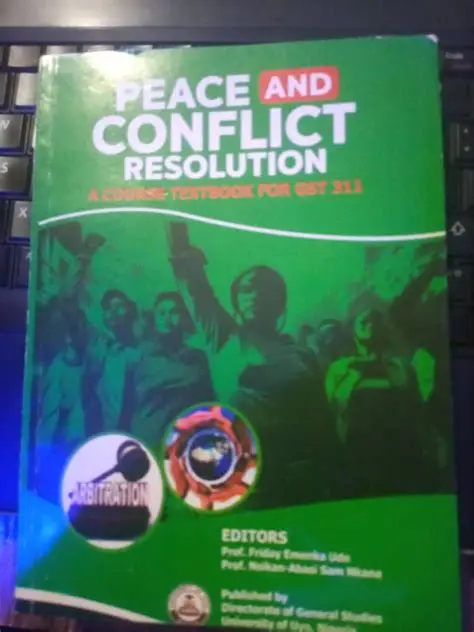
GST 311, Peace and Conflict Resolution, is a course introduced into the Nigerian university system under the Core Curriculum and Minimum Academic Standards (CCMAS) framework. The course is designed to equip students with the knowledge and skills needed to understand peace, identify the causes of conflict, and explore effective methods of resolving disputes. It is offered to students across various faculties, particularly those at the 300-level, as part of the general studies curriculum. Its importance lies in the recognition that peace and security are essential foundations for sustainable development, social stability, and national progress. By studying this course, students gain a better understanding of their roles in promoting peaceful coexistence within their communities and society at large.
The course examines fundamental concepts such as peace, conflict, conflict resolution, and security. It explains the meanings of these concepts, their relationships, and their relevance to everyday life. Students are introduced to different forms and types of conflict, including interpersonal, communal, political, religious, ethnic, and organisational conflicts. Understanding these categories helps students recognise that conflicts can arise from different circumstances and require appropriate approaches to resolution. The course also emphasises the importance of identifying the underlying causes of disputes rather than focusing only on their visible effects.
Another important area covered in GST 311 is the role of communication and the media in conflict resolution. The course explores how conventional media, including radio, television, and newspapers, as well as new media platforms, can influence public opinion and affect the development or resolution of conflicts. It also considers the role of language in communication, negotiation, mediation, and reconciliation. Appropriate language and responsible communication can encourage understanding, reduce tension, and promote peaceful dialogue, while misinformation, inflammatory statements, and hate speech can worsen existing disputes.
The course also examines the causes of conflict, strategies for resolving disputes, and the challenges associated with post-conflict situations. Students learn about approaches such as negotiation, mediation, dialogue, reconciliation, and other peaceful methods of settling disagreements. Legal perspectives on conflict resolution are also considered, helping students understand the importance of laws, justice, human rights, and established institutions in maintaining peace. Furthermore, environmental insecurity is discussed as a potential source of conflict, particularly where competition over land, water, natural resources, and other essential needs creates tension among individuals or communities.
In conclusion, GST 311, Peace and Conflict Resolution, is an important course that promotes peaceful coexistence, responsible citizenship, and the development of practical conflict management skills. Its broad coverage of peace, security, communication, legal principles, environmental issues, and post-conflict recovery makes it relevant to students across different academic disciplines. The knowledge gained from the course can be applied in personal relationships, workplaces, communities, and national affairs. Studying peace and conflict resolution therefore helps students appreciate the value of dialogue, tolerance, mutual understanding, and justice in building a peaceful society. It is a worthwhile academic subject that contributes to personal development and supports the wider goal of sustainable national development.
The Book is 180 pages in number, written by 15 authors and 12 chapters
PRINTED IN NIGERIA BY Wilonek Publishers Uyo, Akwa Ibom State
ISBN: 978-978-45210-2-1
Book Review on Peace and Conflict Resolution: An Assignment On GST 311
Assignment Question
UNIVERSITY OF UYO
FACULTY OF SOCIAL SCIENCES
DEPARTMENT OF PEACE STUDIES AND CONFLICT RESOLUTION
INTERNAL MEMORANDUM
To: All GST 311 Students
From: Course Coordinator
Date: 17th December, 2025
Subject: Book Review Assignment – GST 311 (Peace and Conflict Resolution)
This is to inform all students offering GST 311 – Peace and Conflict Resolution that a term paper assignment has been given as part of the course requirements.
Assignment Instruction:
Each group (GPS) is to summarize a chapter from the GST 311 textbook as follows:
– GPS 1 & 13 – Chapter 4
– GPS 2 & 14 – Chapter 5
– GPS 3 & 15 – Chapter 7
– GPS 4 & 16 – Chapter 6
– GPS 5 & 17 – Chapter 8
– GPS 6 & 18 – Chapter 12
– GPS 7 & 19 – Chapter 1
– GPS 8 & 20 – Chapter 2
– GPS 9 & 21 – Chapter 9
– GPS 10 & 22 – Chapter 10
– GPS 11 & 23 – Chapter 11
– GPS 12 & 24 – Chapter 3
Submission Guidelines:
– Submit on or before Week 7 (Wednesday, January 28, 2026).
– Submit to the lecturer in the venue through your class representative.
– All submissions must be:
– Handwritten on foolscap sheets
– Properly enclosed in a flat file
Clearly labelled with your name, matric number, and group number
– Recorded in the submission register
Please treat this as important.
Signed:
Course Coordinator
GST 311 – Peace and Conflict Resolution


No comments yet. Be the first to share your thoughts.