
The Impact of Human Activities on the Ecosystem
INTRODUCTION
Human activities have significantly transformed the Earth’s surface, oceans, and atmosphere, particularly over the past two centuries (Turner, 1990). These changes have raised concerns about the sustainability of natural resources and the ability of ecosystems to support growing human populations. This situation reflects the concerns expressed by Thomas Malthus, who argued that unchecked population growth could eventually exceed the capacity of available natural resources to meet human needs. As populations increase, the demand for land, food, water, energy, and other resources also rises, placing greater pressure on the natural environment. Consequently, human activities such as urbanization, industrialization, deforestation, and agricultural expansion have contributed to environmental degradation and the loss of biodiversity. These pressures threaten ecological balance and highlight the need for sustainable resource management and effective environmental conservation.
In addition to climate change, several other factors threaten the effectiveness of protected areas and the survival of vulnerable species. Increasing human population density, intensified land use, the introduction of invasive species, habitat fragmentation, and limited opportunities for species dispersal can disrupt ecological processes and reduce biodiversity. These pressures affect the ability of protected areas to preserve wildlife and maintain functioning ecosystems. Protected areas often provide essential habitats and refuges for endangered species, particularly where natural habitats outside their boundaries have been degraded or destroyed. However, changing climatic conditions can intensify existing environmental pressures by altering habitat suitability, species distribution, and the availability of food and water. Vos et al. (2008) and Beaumont et al. (2009) highlight the importance of considering the combined effects of climate change and other environmental pressures when assessing the future effectiveness of protected areas.
The relationship between economic development and environmental degradation is also a major concern. Between 1990 and 2005, global forest area declined by approximately 3.1%, while the world’s gross domestic product increased by about 32%. These figures illustrate that economic growth can occur alongside significant losses of natural resources, although the figures alone do not establish a direct causal relationship between the two trends. Díaz et al. (2006) discuss how human-induced changes to biodiversity and ecosystems can reduce the benefits people obtain from ecosystem services, including food production, water regulation, soil fertility, and other essential ecological functions. Although economic development can improve living standards, its long-term benefits may be undermined when it depends on unsustainable resource exploitation. Therefore, development strategies need to account for environmental costs and protect the ecological systems upon which human well-being depends.
The Pantanal, a major wetland ecosystem in South America, illustrates the environmental consequences of human activities. According to Alho et al. (2011), the introduction of exotic plant and animal species, whether deliberate or accidental, has altered natural ecological communities within the region. Other pressures, including deforestation, agricultural expansion, illegal fishing and hunting, poorly planned tourism, and pesticide pollution, have contributed to the deterioration of natural habitats. The growing demand for soybean cultivation on the upland plateaus surrounding the Pantanal has also increased the use of agricultural chemicals, raising concerns about their potential effects on soil, water quality, aquatic organisms, and wildlife (Alho, 2005; Harris et al., 2005, 2006). These challenges demonstrate the need for integrated environmental policies that balance economic activities with ecosystem protection. Strengthening protected areas, regulating land use, controlling invasive species, reducing pollution, and promoting sustainable agriculture are important measures for conserving biodiversity and maintaining the ecological functions of the Pantanal and other vulnerable ecosystems.
The Impact of Human Activities on the Ecosystem
THE CONCEPT OF ECOSYSTEM
Ecosystem, as defined by the Convention on Biological Diversity means a dynamic complex of plant, animal and microorganism communities and their non-living environment interacting as a functional unit (UNEP 1992). Conservation of the ecosystem entails preservation and regulated utilization of the ecosystem. In the Tanzania forest policy, the objective of ecosystem conservation and management is stated as to ensure ecosystem stability through conservation of forest biodiversity, water catchments and soil fertility.
An ecosystem is a community of plants, animals, and smaller organisms that live, feed, reproduce, and interact in the same area or environment. Ecosystems can be very large, such as the Amazon rainforest, or very small, such as a pond. Ecosystems dwell within larger ecosystems, all within the giant ecosystem that is Planet Earth, and for hundreds of thousands of years human beings have been a part of this dynamic interaction. But the last couple of centuries have seen unprecedented advances in human technology and population, and we have now grown into a dangerous force that threatens our wider home.
IMPACT OF HUMAN OCCUPATION ON THE ECOSYSTEM
Humanity faces the growing irony that ‘human activities’ are both the cause and solution to our current crisis. It is widely accepted that human activities are major contributing factors in global climate change, biodiversity losses, and ecosystem degradation (Foley et al., 2005; Pachauri & Reisinger, 2007; Vitousek, Mooney, Lubchenco, & Melillo, 1997; Wackernagel et al., 2002). At the same time, changes in everyday human activities are proposed as essential components of a response to global environmental change (Dietz, Gardner, Gilligan, Stern, & Vandenbergh, 2009; Ikiugu, 2008; Stern, 2000).
Human activity is also thought to be an important factor promoting resilience in social-ecological systems (Blaikie & Brookfield, 1987; Davidson-Hunt & Berkes, 2003). Yet, while all the human sciences deal with human activity in some way, scientists have not yet reached a shared framework for understanding this concept. The term human activity has become widely used in environmental fields as the most encompassing designation; other terms that are frequently employed in the environmental literature include ‘human impacts’ and ‘human dimensions’. These latter terms have the advantage of making explicit the idea of human causality (Meyer, 2009), but none of these are analytical categories normally used in the social sciences. These sciences dissect human activity as their time (Meyer, 1922; Pierce, 2003; Pisˇkur, Kine´banian, & Josephsson, 2002; Wilcock, 2006).
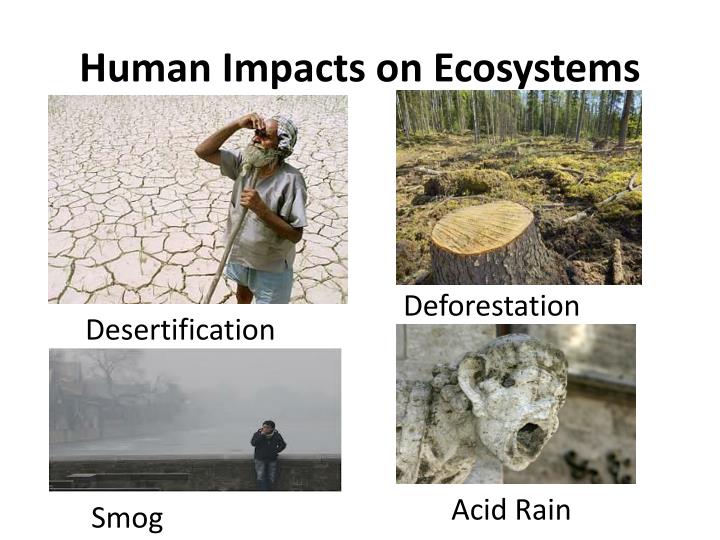
This planet has seen five major extinction events that we know of prior to human civilisation. The first was almost 440 million years ago, and wiped out some 85% of species. The other major extinction events include the dinosaur extinction 65 million years ago, which wiped out three quarters of the planet’s species. And now, as you read this seems we are in the middle of the planet’s sixth great extinction. This time it is human forces rather than environmental ones that are to blame16. This is a cause for great concern (where did we go wrong?) but also a cause for great optimism (if we are causing it then we can fix it). What are the major human-driven impacts on this planet’s ecosystems?
IMPACT OF LAND UTILIZATION ON ECOSYSTEM
Land use is a major anthropogenic change that has reshaped the earth’s surface, thereby affecting all of the earth’s ecological functions (Steffen et al., 2007). Thus, understanding the impacts of land use change (“land use science”) is essential for mitigating the consequences of human–environment interactions. Agricultural land use may also result in loss of native habitats or increased wind erosion and dust, exposing humans to particulate matter and various chemicals. Some land uses can accelerate or exacerbate the spread of invasive species. For example: Certain agricultural land use practices, such as overgrazing, land conversion, fertilization, and the use of agricultural chemicals, can enhance the growth of invasive plants.5 These plants can alter fish and wildlife habitat, contribute to decreases in biodiversity, and create health risks to livestock and humans. Introduction of invasive species on agricultural lands can reduce water quality and water availability for native fish and wildlife species.
Research is beginning to elucidate the connections between land use changes and infectious disease. For example, some studies indicate that spread of vector-borne disease may be influenced by land use and/or other environmental change. Other studies indicate that fragmentation of forest habitat into smaller patches separated by agricultural activities or developed land increases the “edge effect” and promotes the interaction among pathogens, vectors, and hosts. In some cases, changes in land use may have positive effects, such as increasing habitat (as a result of deliberate habitat restoration measures) and reclamation of previously contaminated lands for urban/suburban development.
IMPACT OF HUMAN POPULATION ON ECOSYSTEM
Ecologists have long understood the concept of “carrying capacity” – the maximum population of a given species that can survive indefinitely in a given environment25. Within an ecosystem a species cannot expand its population beyond the food/resources available to sustain it – any attempts will draw down upon those resources and, in turn, force the population to shrink. In this way ecosystem equilibrium is maintained. But when humans began manipulating their environment through farming and technology it allowed increases in population. After all, a field entirely planted with edible crops can feed more mouths than a forest scattered with edible plants24. Our distant transition from hunter-gatherer societies to farming societies was ultimately a decision to increase food production rather than limit population. But for all the gains in the efficiency of our technology and production methods, there will always exist an upper limit to the amount of resources humans can sustainably use up – we cannot extend the human carrying capacity of our environment beyond that limit.
Over population lads to overexploitation of natural resources directly correlates with the need to provide food and housing to an ever-growing human population. Overfishing, for example, removes fish from the oceans faster than they can be replaced through reproduction, stressing the balance of the ecosystem. Burning fossil fuels and cutting old-growth forests are other examples of overexploitation, as these resources can’t be replaced once they are gone. However, over population lead also leads to Pollution occur when harmful substances enter the environment. Examples of pollutants include disruptive light or noise from human activities, or harmful chemical wastes. For example, the nitrogen in fertilizer runoff can induce the rapid overgrowth of algae in oceans. These algal blooms choke the surrounding waters of available oxygen, resulting in dead zones, or nutrient-depleted regions that can’t support plant or animal life.
MANAGEMENT AND CONSERVATION OF THE ECOSYSTEM
To reduce humanity’s impact upon our precious ecosystems, which have both an innate value and pivotal role in our survival, we need to start slowing down population growth, and reversing trends of high consumption in the industrialised world. Measures to slow population growth cannot include increases in mortality, and therefore have to work on reducing fertility. Three major areas for focus are:
(1) Strengthen family planning programs – approximately one quarter of births in the “developing” world are unwanted, and a larger proportion still is unplanned. Lack of contraception contributes to these unwanted pregnancies, as well as poor family planning services.
(2) Reduce the cultural demand for large families – in many parts of the world the desire for large families is driven by fear of infant and child mortality, as well as the need for children to assist in family enterprises and to support their parents in old age. The most effective measures to reduce demand for large families are to:
(a) Lower the child mortality rate by implementing public health measures, including the provision of safe drinking water and adequate nutrition.
(b) Provide education for children – educated parents rely less upon children for income and social survival, and education also promotes and facilitates the spread of non-traditional behaviours, roles, and values.
(c) Improve the economic, social and legal status of women – empowering women leads to reductions in the desire for male offspring, the dominance of husbands over women, and the need for children as insurance against adversity.
(3) Encourage a delay in childbearing until an older age, thus reducing the momentum of population growth. This can be achieved through investment in secondary education, as well as income-generating potential.
All of these options require an investment of resources that poorer nations often do not have, and so it could be argued that there is a responsibility for the world’s wealthy nations to contribute. Reducing consumption levels in the first world is equally important as reducing the rate of population increase in the third world. We consume far more than our fair share of the planet’s resources. If everybody on the planet were to consume at the same rate as Australians, we would need. Earths to provide the resources and absorb the waste at a renewable rate. If everybody were to consume at the same rate as North Americans we would need. Communities around the world are choosing a simpler, sustainable lifestyle. These people are choosing to invest savings in self-sufficiency with regard to food, water and energy needs. For many people this shift in priorities results in more time to devote to friends, family and community activities. This in turn leads to health, happiness and harmony with the environment.
Conclusion
In conclusion, rapid population growth and the increasing demand for the Earth’s natural resources have been intensified by a cultural phenomenon known as consumerism. Consumerism refers to the tendency of people to seek meaning, happiness, satisfaction, and social acceptance through the goods and services they consume. It is strongly encouraged through advertising and other marketing strategies that repeatedly persuade individuals that spending money can relieve anxiety, overcome self-doubt, and provide an escape from the difficulties and routine of everyday life. As a result, consumption often extends beyond the satisfaction of basic human needs and becomes a means of seeking personal fulfilment and social recognition.
As people consume more than they require for their basic survival, they increasingly satisfy their wants, many of which are continually created or reinforced by consumer culture. This pattern of consumption increases the ecological footprint of individuals and societies by placing greater pressure on natural resources, energy supplies, land, water, and waste-management systems. Although meeting basic needs is essential for human well-being, excessive consumption can contribute to environmental degradation, resource depletion, pollution, and the destruction of natural habitats.
Human wants are virtually limitless, while the Earth’s resources and capacity to absorb waste are finite. Therefore, making happiness dependent on the continuous satisfaction of material desires can be unsustainable both personally and environmentally. The more societies pursue excessive consumption without considering its ecological consequences, the greater the pressure placed on the planet’s natural systems. When this pressure exceeds the Earth’s carrying capacity, ecosystems may become unable to regenerate resources or absorb waste at a sustainable rate. This highlights the need for responsible consumption, resource conservation, and more sustainable lifestyles that balance human well-being with environmental protection. Ultimately, the growing ecological footprint of human activities demonstrates the urgent need to reconsider consumer habits and adopt practices that support the long-term health of the planet.
References
Millennium Ecosystem Assessment. (2005). Ecosystems and Human Well-being: Biodiversity Synthesis. World Resources Institute: Washington DC
Proffitt, F. & P. Bagla. (2004). Circling In on a Vulture Killer. In Science. Vol 306, Oct 8, 2004.
Alho, C. JR., Mamede, S., Bitencourt, K. and Benites, M. (2011) Introduced species in the Pantanal: implications for conservation Braz. J. Biol.,vol. 71, no. 1 (suppl.), p. 321-325.
Beaumont L.J., Gallagher R.V., Downy P.O., Thuiller W., Leishman M. R. and Hughes
L, (2009) Modelling the impact of Hieracium spp. on protected areas in Australia under future climates. Ecography, 32:757-764.
Harris, M. C., Arcângelo, C., Pinto, E. C. T., Camargo, G., Ramos-Neto, M. B. and Silva,
- M., (2006) Estimativa da perda de cobertura vegetal original naBacia do Alto Paraguai e Pantanalbrasileiro: ameaças e perspectivas. Natureza e Conservação, vol. 4, no. 2, p. 50-66.
Lo´pez-Lo´pez P. Ferrer M., Madero A., Casado E., McGrady M. (2011) Solving ManInduced Large-Scale Conservation Problems: The Spanish Imperial Eagle and Power Lines. Plosone 6(3) e17196.



No comments yet. Be the first to share your thoughts.