

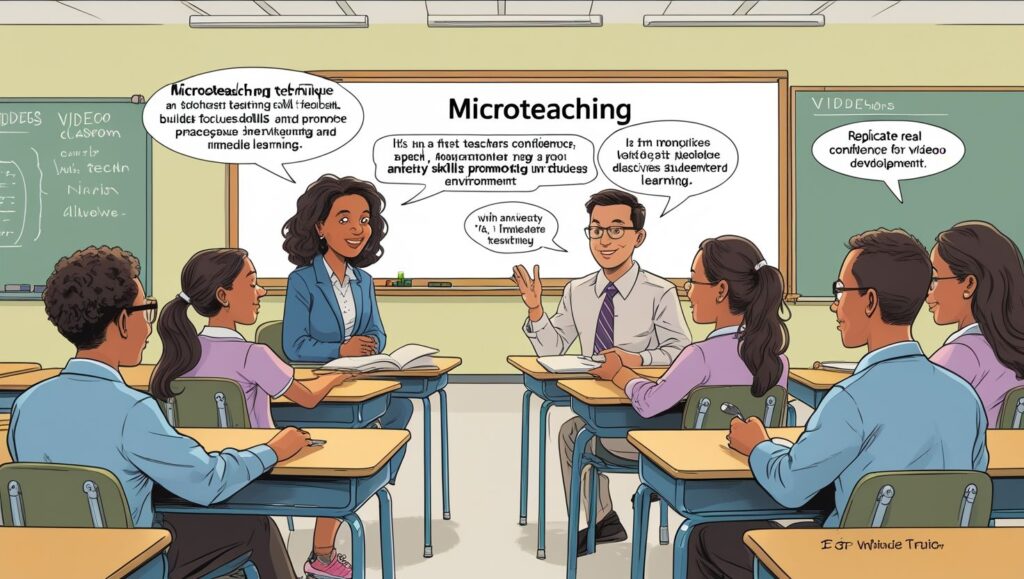
Microteaching and teaching practice are two fundamental components of teacher education programmes that prepare prospective teachers for effective classroom instruction. Both approaches provide pre-service teachers with opportunities to apply educational theories, develop practical teaching skills, and understand the responsibilities associated with the teaching profession. Through these experiences, student teachers learn how to plan lessons, communicate subject content, manage learners, use instructional materials, ask relevant questions, and assess students’ understanding. Although both components aim to improve teaching competence and professional confidence, they differ in their structure, scope, duration, learning environment, and level of responsibility assigned to the trainee teacher.
Microteaching is a structured teacher-training technique in which a student teacher practises specific teaching skills within a simplified classroom setting. A typical microteaching session involves teaching a small group of learners or peers for a short period, focusing on one or a few instructional skills at a time. These skills may include lesson introduction, explanation, questioning, reinforcement, classroom communication, and the effective use of teaching aids. The session is usually followed by feedback from supervisors, lecturers, or peers, allowing the trainee to identify strengths and areas requiring improvement. This process enables prospective teachers to practise, reflect on their performance, and refine their instructional methods before handling a full classroom.
Teaching practice, on the other hand, involves placing student teachers in actual school environments to gain practical experience under the guidance of experienced teachers and supervising lecturers. During this period, trainees take on broader teaching responsibilities, including preparing lesson plans, teaching complete lessons, managing classrooms, assessing learners, maintaining relevant records, and participating in other school activities as required. Unlike microteaching, which usually concentrates on particular teaching skills in a controlled setting, teaching practice exposes trainees to the complexities of everyday classroom life. It allows them to work with learners of different abilities, respond to unexpected classroom situations, and understand how school policies, available resources, and the wider learning environment influence teaching and learning.
Despite these differences, microteaching and teaching practice share several important characteristics. Both provide opportunities for practical learning, encourage the application of educational theories, and help prospective teachers develop the skills required for professional classroom instruction. They also involve observation, supervision, feedback, and reflection, which enable trainees to evaluate their performance and improve their teaching methods. In addition, both experiences can strengthen communication skills, professional responsibility, lesson preparation, and confidence in handling learners. When properly organised, they complement one another by allowing student teachers to develop basic instructional skills before applying and adapting those skills in real school settings.
A comparative analysis of microteaching and teaching practice therefore highlights their complementary roles in teacher preparation rather than suggesting that one can completely replace the other. Microteaching offers a controlled opportunity to practise and improve particular teaching skills, while teaching practice provides a broader experience of professional teaching responsibilities in an authentic school environment. Together, they contribute to the development of reflective, competent, and adaptable teachers who can connect educational theory with classroom practice. Their effectiveness, however, depends on adequate preparation, constructive supervision, useful feedback, access to appropriate teaching resources, and opportunities for student teachers to reflect on their experiences. Integrating both components into teacher education programmes can help ensure that prospective teachers are better prepared to meet the instructional, professional, and interpersonal demands of the teaching profession.
Definitions
Microteaching: Microteaching is a teacher training technique developed in the 1960s that involves teaching a small group of peers for a short period, focusing on practicing specific teaching skills (Allen & Ryan, 1969). The goal is to break down the complex task of teaching into manageable components for focused skill development.
Teaching Practice: Teaching practice, also known as practice teaching or student teaching, involves extended periods of teaching in real classroom settings where trainee teachers apply their acquired knowledge under the supervision of experienced mentors (Kiggundu & Nayimuli, 2009). It serves as a bridge between theoretical knowledge and actual classroom experience.
Similarities Between Microteaching and Teaching Practice
- Skill Development:
- Both focus on developing essential teaching skills such as lesson planning, classroom management, questioning techniques, and effective communication (Richards & Farrell, 2005).
- Teacher Training Tools:
- Both are essential components in teacher education programs aimed at improving instructional techniques and strategies (Zeichner, 2010).
- Practice-Oriented:
- Both emphasize hands-on practice, allowing trainees to implement theoretical knowledge in practical situations (Cruickshank, 1996).
- Feedback Mechanism:
- Both emphasize the importance of receiving constructive feedback from mentors, peers, and supervisors for continuous improvement (Flanders, 1970).
- Structured Learning:
- Both follow a systematic and structured format, including planning, teaching, observing, and reflecting.
- Performance Evaluation:
- Trainees in both settings are assessed based on their teaching effectiveness, interaction with learners, and instructional clarity (Hagger & McIntyre, 2006).
- Supervision and Guidance:
- Both involve guidance from experienced educators who provide mentoring throughout the process (Marais & Meier, 2004).
- Simulation of Real Classroom Experience:
- While microteaching is a scaled-down version, both offer a platform to practice real-world teaching scenarios (Allen, 1967).
- Focus on Specific Teaching Skills:
- Both emphasize the practice of specific teaching skills, such as effective questioning and time management.
- Objective of Professional Growth:
- Both aim at enhancing the professional competence and readiness of pre-service teachers (Darling-Hammond, 2006).
Differences Between Microteaching and Teaching Practice
| Aspect | Microteaching | Teaching Practice |
|---|---|---|
| Scale and Scope | Small group of peers in a controlled setting | Full classroom experience with real students |
| Duration | Short sessions (10-20 minutes) | Extended period (weeks to months) |
| Focus | Focused on mastering specific skills | Broader focus on overall teaching experience |
| Feedback Cycle | Immediate and frequent | Periodic with formal evaluations |
| Supervision | Peers and instructors provide feedback | Mentor teachers and school supervisors |
| Risk Level | Low-risk environment | Real classroom challenges and dynamics |
Summary and Conclusion
In summary, microteaching and teaching practice are essential components of teacher education that contribute to the professional development of prospective teachers. Both approaches aim to improve instructional competence by helping student teachers develop the knowledge, skills, confidence, and professional attitudes required for effective classroom teaching. Through these experiences, prospective teachers learn to plan lessons, communicate ideas clearly, select appropriate teaching methods, manage learners, and assess learning outcomes. They also gain opportunities to reflect on their performance, identify areas for improvement, and apply feedback to strengthen their instructional abilities.
However, microteaching and teaching practice contribute to teacher development in different but complementary ways. Microteaching provides a controlled environment in which student teachers can practise specific teaching skills, receive constructive feedback, and improve their performance before assuming broader classroom responsibilities. Teaching practice, in contrast, exposes them to the realities of school life, where they apply their knowledge and skills while managing actual classrooms, responding to learners’ needs, and fulfilling other teaching responsibilities. Integrating both approaches into teacher education programmes provides a more comprehensive preparation process by connecting theoretical understanding with practical experience. This combination can help produce reflective, competent, and adaptable teachers who are better equipped to respond to the demands of the teaching profession.
References
Allen, D., & Ryan, K. (1969). Microteaching. Addison-Wesley. Cruickshank, D. R. (1996). Preparing America’s Teachers.
McGraw-Hill. Darling-Hammond, L. (2006). Powerful Teacher Education. Jossey-Bass. Flanders, N. A. (1970). Analyzing Teaching Behavior. Addison-Wesley.
Hagger, H., & McIntyre, D. (2006). Learning Teaching from Teachers. Open University Press.
Kiggundu, E., & Nayimuli, S. (2009). Teaching practice: A make or break phase for student teachers. South African Journal of Education, 29(3), 345-358.
Marais, P., & Meier, C. (2004). Hear our voices: Student teachers’ experience during practical teaching. South African Journal of Education, 24(2), 129-134.
Richards, J. C., & Farrell, T. S. C. (2005). Professional Development for Language Teachers. Cambridge University Press. Zeichner, K. (2010). Reflective Teaching: An Introduction. Routledge.




No comments yet. Be the first to share your thoughts.