

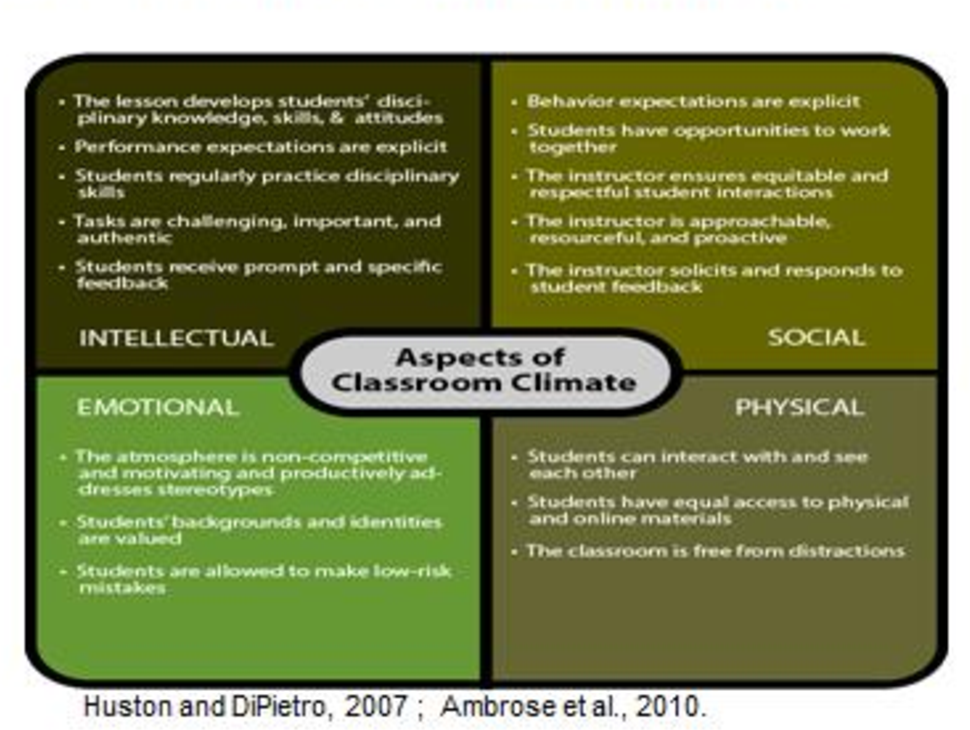
Relationship between Academic Performance and Dimensions of Classroom Climate
By
Dosan, S. & Dimic, N.
- Introduction
Dosan and Dimic (2019) investigated the relationship between classroom climate and students’ academic performance, focusing on several dimensions of the classroom environment. These included teacher-student interaction, social climate, fear of failure, and emotional climate. The study examined how these factors were associated with students’ academic outcomes and further explored whether perceptions of classroom climate differed according to socio-demographic characteristics, particularly gender and age. By considering these dimensions, the researchers sought to develop a clearer understanding of how students’ classroom experiences relate to their educational performance.
The study addressed an important issue in educational research because the classroom environment can influence students’ experiences, participation, motivation, and attitudes toward learning. Teacher-student interaction, for example, concerns the nature of communication and relationships between teachers and learners, while social climate reflects the quality of relationships among students and the general atmosphere within the classroom. Fear of failure relates to students’ concerns about making mistakes or performing poorly, whereas emotional climate concerns the feelings and emotional conditions associated with the learning environment. Examining these dimensions can help educators identify aspects of classroom life that may require attention when developing strategies to support learning.
According to the findings reported in the study, there was no statistically significant correlation between the overall classroom climate components examined and academic performance. This suggests that the researchers did not find sufficient statistical evidence of a relationship between these classroom climate dimensions, considered in their analysis, and students’ academic performance. However, this result should not be interpreted as proof that classroom climate has no influence on learning. Academic performance is a complex outcome that may be associated with several interacting factors, including students’ prior knowledge, motivation, study habits, family background, teaching methods, and access to learning resources.
Despite the absence of a statistically significant overall correlation, the study identified differences in particular dimensions of classroom climate based on gender and age. This finding suggests that students’ experiences or perceptions of the classroom environment may vary across demographic groups. Such differences are relevant to educators because students may not respond to classroom interactions, social relationships, emotional pressures, or fear of failure in exactly the same way. Understanding these variations can help teachers create learning environments that recognize students’ diverse experiences and encourage participation, confidence, and positive relationships.
The study by Dosan and Dimic (2019) therefore contributes to the discussion of classroom climate and academic performance by highlighting both the complexity of their relationship and the potential relevance of students’ socio-demographic characteristics. Although the reported findings did not establish a statistically significant correlation between the classroom climate components and academic performance, the differences associated with gender and age indicate areas that may benefit from further investigation. For the present study, this research provides a useful basis for examining classroom climate in relation to students’ learning experiences and academic outcomes, while recognizing that the nature of these relationships may depend on the population, educational setting, and other factors considered in the research.
- Research Objectives
The primary objectives of this study were:
- To examine the relationship between academic performance and classroom climate dimensions (teacher-student interaction, social climate, fear of failure, emotional climate).
- To investigate the relationship between classroom climate components and socio-demographic variables, particularly gender and age.
- To assess how classroom climate may indirectly influence academic performance.
- Research Hypotheses
The study tested the following hypotheses:
- There is no statistically significant relationship between the components of classroom climate and academic performance.
- Gender has no significant effect on classroom climate dimensions.
- Age does not significantly influence the classroom climate components.
- Methodology
4.1 Research Design
The study employed a survey research design to collect and analyze data from sixth and eighth-grade students in Leskovac, Serbia. This design was selected to gather detailed information on students’ perceptions of classroom climate and its relationship to academic performance.
4.2 Population and Sample
The population for the study consisted of all sixth and eighth-grade students from elementary schools in Leskovac. Using Taro Yamene’s formula, a sample of 180 students was selected. The multi-stage sampling technique was adopted to ensure a representative sample that included a mix of students based on age and gender.
4.3 Instrument for Data Collection
A self-designed questionnaire was used to collect data. The questionnaire included items measuring four dimensions of classroom climate (teacher-student interaction, social climate, fear of failure, and emotional climate) and students’ academic performance. Socio-demographic data such as gender and age were also collected.
4.4 Data Analysis
The data were analyzed using Analysis of Covariance (ANCOVA) to test the relationships between classroom climate components, socio-demographic variables, and academic performance. All hypotheses were tested at a 0.05 level of significance.
- Results
5.1 Relationship Between Classroom Climate Components and Academic Performance
The results of the study indicated no statistically significant correlation between the classroom climate components and academic performance. This finding suggests that while classroom climate may influence students’ learning experiences, its direct impact on academic outcomes may not be significant.
5.2 Gender Differences in Classroom Climate Components
Gender differences were observed in certain classroom climate components. Boys scored higher on the “social climate” dimension, indicating that they were more engaged in the social aspects of the classroom environment. On the other hand, “fear of failure” was more expressed among girls, suggesting that female students may experience more anxiety related to academic performance.
5.3 Age Differences in Classroom Climate Components
Younger students (sixth graders) had higher scores on the “teacher-student interaction” and “emotional climate” components compared to older students (eighth graders). This finding may indicate that younger students place more importance on the emotional and relational aspects of their classroom experience, while older students may focus more on academic content.
- Discussion
The results of the study are partially consistent with previous research, which has highlighted the importance of classroom climate in shaping students’ academic experiences. While no direct link between classroom climate components and academic performance was found, the study emphasizes the importance of the classroom environment in shaping students’ social and emotional well-being. The observed differences in gender and age suggest that classroom climate should be tailored to meet the specific needs of different student groups.
- Conclusion
The findings of this study underscore the complexity of the relationship between classroom climate and academic performance. While classroom climate did not directly correlate with academic outcomes, it appears to play an important role in influencing students’ emotional and social experiences in school. Further research is needed to explore the indirect effects of classroom climate on academic performance, as well as the role of other mediating variables such as motivation and self-efficacy.
- Recommendations
Based on the study’s findings, the following recommendations are made:
- Teachers and school administrators should focus on creating a positive social and emotional climate in classrooms, particularly for younger students.
- Interventions aimed at reducing fear of failure, especially among female students, should be implemented to enhance their confidence and academic engagement.
- Further research should investigate the mediating factors that may link classroom climate to academic performance.
- Limitations of the Study
The study was limited by its focus on a single geographic area (Leskovac) and a relatively small sample size. Future studies could expand the sample to include students from different regions and educational contexts to enhance the generalizability of the findings. Additionally, the study relied on self-reported data, which may be subject to bias.
References
Fraser, B. J. (2012). Classroom environment. Routledge International Companion to Education, 53(2), 123-134. https://doi.org/10.4324/9780203828845
Wang, M. C., Haertel, G. D., & Walberg, H. J. (2013). Toward a knowledge base for school learning. Review of Educational Research, 63(3), 249-294. https://doi.org/10.3102/00346543063003249
Pianta, R. C., Hamre, B. K., & Allen, J. P. (2014). Teacher-student relationships and engagement: Conceptualizing, measuring, and improving the capacity of classroom interactions. Educational Psychologist, 45(1), 87-100. https://doi.org/10.1080/00461521003612578
Patrick, H., Ryan, A. M., & Kaplan, A. (2007). Early adolescents’ perceptions of the classroom social environment, motivational beliefs, and engagement. Journal of Educational Psychology, 99(1), 83-98. https://doi.org/10.1037/0022-0663.99.1.83
Dorman, J. P. (2003). The impact of classroom environment on student self-concept and motivation. Learning Environments Research, 6(2), 111-134. https://doi.org/10.1023/A:1023269908176
Wentzel, K. R. (2016). Social relationships and motivation in middle school: The role of parents, teachers, and peers. Journal of Educational Psychology, 95(2), 165-178. https://doi.org/10.1037/0022-0663.95.2.165
Eccles, J. S., & Roeser, R. W. (2009). Schools, academic motivation, and stage-environment fit. Handbook of Adolescent Psychology, 2(2), 404-434. https://doi.org/10.1002/9780470479193.adlpsy002013
Thapa, A., Cohen, J., Guffey, S., & Higgins-D’Alessandro, A. (2013). A review of school climate research. Review of Educational Research, 83(3), 357-385. https://doi.org/10.3102/0034654313483907
Johnson, W., Crosnoe, R., & Elder, G. H. (2011). Student attachment and academic engagement: The role of school climate. American Sociological Review, 66(2), 352-369. https://doi.org/10.2307/2657468




No comments yet. Be the first to share your thoughts.