

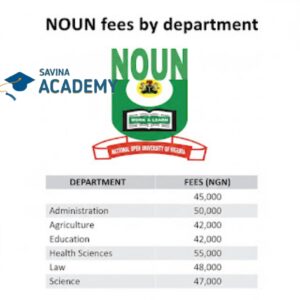
This page presents a clear and carefully structured breakdown of noun school fees across all faculties and programmes. The figures shared here reflect the current fee structure used by the university, with adjustments that usually apply to new intakes and returning students. While NOUN fees are subject to periodic review, the cost remains one of the lowest among federal universities in Nigeria.
How NOUN School Fees Are Structured
Unlike conventional universities where fees are paid as a single lump sum, NOUN adopts a modular system. Students pay based on programme type, course load, and study level. This approach makes fee payment more predictable and manageable.
Generally, NOUN school fees are grouped into:
- Application and acceptance fees
- Registration and course material fees
- Examination and facilitation charges
Most payments are made online through the official university portal. Students are advised to avoid third parties and always confirm payment details from the official NOUN website.
NOUN School Fees for Undergraduate Programmes
Undergraduate programmes at NOUN cut across Arts, Social Sciences, Management Sciences, Education, Science, Health Sciences, and Law. The fees vary slightly depending on the faculty and number of credit units registered per semester.
Faculty of Arts and Social Sciences
Programmes under this category include English, History and International Studies, Economics, Political Science, Sociology, and Mass Communication.
- New students: ₦60,000 – ₦75,000 per session
- Returning students: ₦45,000 – ₦65,000 per session
Courses in this faculty usually attract lower laboratory or practical fees, which helps keep the overall cost moderate.
Faculty of Management Sciences
This faculty covers Business Administration, Accounting, Entrepreneurship, Public Administration, and Marketing.
- New students: ₦65,000 – ₦80,000 per session
- Returning students: ₦50,000 – ₦70,000 per session
Students offering professional-related courses may pay slightly higher facilitation fees due to course materials and assessments.
Faculty of Education
Education programmes remain popular at NOUN, especially among working teachers seeking professional advancement.
- New students: ₦55,000 – ₦70,000 per session
- Returning students: ₦40,000 – ₦60,000 per session
Teaching practice and project supervision fees are usually charged separately at the appropriate level.
Faculty of Science and Health Sciences
Courses such as Computer Science, Mathematics, Biology, Physics, Environmental Science, and Public Health fall under this category.
- New students: ₦70,000 – ₦90,000 per session
- Returning students: ₦55,000 – ₦80,000 per session
Programmes with laboratory components tend to attract higher fees due to practical requirements.
Faculty of Law
Law remains one of the most competitive programmes at NOUN.
- New students: ₦85,000 – ₦100,000 per session
- Returning students: ₦70,000 – ₦90,000 per session
Additional costs may apply for moot court activities and professional examinations.
NOUN School Fees for Postgraduate Programmes
Postgraduate programmes at NOUN include Postgraduate Diplomas, Master’s degrees, and Doctorate programmes. Fees are generally higher than undergraduate programmes but remain affordable when compared with other federal universities.

Postgraduate Diploma (PGD)
- PGD programmes: ₦90,000 – ₦120,000 per session
PGD programmes are common among candidates transitioning into new academic fields.
Master’s Degree Programmes
Master’s programmes cut across Education, Business Administration, Public Health, International Relations, and Information Technology.
- Master’s programmes: ₦110,000 – ₦150,000 per session
Project supervision and thesis assessment fees are typically charged at the final stage.
Doctor of Philosophy (PhD)
- PhD programmes: ₦150,000 – ₦200,000 per session
Doctoral candidates should budget for extended research, proposal defense, and external examination fees.

Additional Charges to Expect
Beyond tuition and course registration, students may encounter other compulsory charges depending on their level and programme.
- Acceptance fee for newly admitted students
- ICT and e-learning support fees
- Project or thesis supervision fees
- Practical or laboratory charges where applicable
These fees are not usually paid at once but spread across the academic session.
Payment Process and Important Notes
All payments for noun school fees are completed through the official student portal. After generating a Remita Retrieval Reference, students can pay online or through approved banks.
It is advisable to keep copies of payment receipts and confirm successful registration before the deadline. Late registration often attracts penalties.
Helpful Resources for NOUN Students
Students who want guidance on admission steps, course registration, or academic planning may find these resources useful:
For official updates, fee confirmations, and policy changes, students should regularly check the university’s official website:
Final Thoughts on NOUN School Fees
The 2026/2027 academic session maintains NOUN’s long-standing reputation as an affordable and accessible university. The flexibility of payment, combined with the absence of accommodation and feeding costs, makes it especially suitable for working-class Nigerians and adult learners.
Understanding the breakdown of noun school fees ahead of time helps students plan properly and avoid unnecessary delays during registration. As with all academic matters, early action and accurate information remain the best approach.